
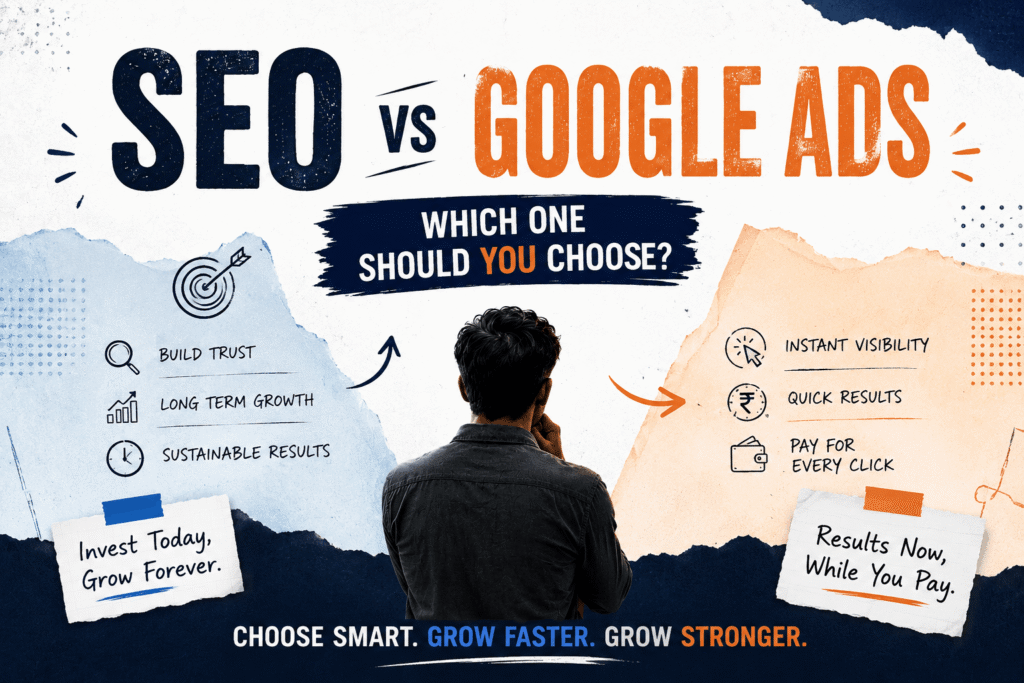
If you are planning to promote your business online, one question will probably come up very quickly:
Should I invest in SEO or Google Ads?
I’ve heard this often from business owners.
Google Ads can bring visibility and enquiries almost immediately, while SEO takes time to build. But SEO can create long-term organic visibility without paying Google for every click.
So, I don’t see SEO vs Google Ads as a competition where one has to win.
They solve different problems.
Google Ads can help you get visibility today. SEO helps you build visibility for tomorrow.
The right choice depends on your business goals, budget, competition and how quickly you need results. And in many situations, the best answer is not SEO or Google Ads.
It is SEO and Google Ads working together.
What is SEO?
Let’s keep this simple.
Search Engine Optimization (SEO) is the process of improving your website so that it becomes more visible in Google’s organic search results for relevant searches.
If someone searches Google for a product or service you provide, naturally you want your website to appear near the top.
SEO helps you work towards that visibility.
It involves your website content, technical structure, keywords, local SEO, authority, user experience and many other factors. An SEO professional works on these areas to improve the website’s organic search presence.
The important thing to understand is that SEO is a long-term process.
Depending on the website, competition and industry, rankings can take time to improve. But once you build strong organic visibility, it can become a valuable source of traffic and enquiries over the long term.
What is Google Ads?
Google Ads allows businesses to advertise on Google and reach people who are actively searching for their products or services.
With Google Search Ads, your advertisement can appear prominently on the search results page for relevant searches.
You generally pay when someone clicks your ad.
You can control your budget, keywords, locations, timings and landing pages, which makes Google Ads particularly useful when you need immediate visibility, leads, calls or sales.
But there is one important difference compared with SEO.
Google Ads requires continuous advertising spend.
When your campaign stops or your budget is exhausted, your paid visibility stops too.
That doesn’t make Google Ads better or worse than SEO. It simply has a different purpose.
SEO vs Google Ads: A Simple Comparison
| SEO | Google Ads |
|---|---|
| Organic search visibility | Paid search visibility |
| Usually takes time to build | Can generate visibility quickly |
| Long-term strategy | Excellent for immediate requirements |
| No payment to Google for each organic click | You generally pay for each Search ad click |
| Builds organic presence over time | Visibility depends on active campaigns and budget |
| Results depend on rankings | Results depend on targeting, competition, budget, ads and landing pages |
One important point here:
SEO is not free.
You may not pay Google for every organic click, but good SEO requires time, expertise, content, technical work and continuous improvement.
So I prefer calling SEO organic traffic, not free traffic.
When is SEO the Better Choice?
SEO makes sense when your business has a long-term goal.
If people regularly search Google for your products or services, building organic visibility can become a valuable business asset.
Imagine running Google Ads successfully for three years without investing in SEO.
As long as you keep spending, the ads can continue generating traffic. But if you significantly reduce or stop the advertising budget, that paid source of traffic can reduce immediately.
Now imagine that during those same three years, you were also investing in SEO.
Your website could gradually build rankings for your products, services, locations and other relevant searches.
That’s why businesses shouldn’t wait until they urgently need organic traffic before starting SEO.
SEO takes time. Start building it early.
When is Google Ads the Better Choice?
Sometimes you simply cannot wait for SEO.
You may have:
- Launched a new business or website.
- Introduced a new product or service.
- Started admissions for a school or college.
- Launched a limited-period offer.
- Entered a new location.
- Needed enquiries or sales immediately.
In these situations, Google Ads can be extremely useful.
If people are already searching for what you offer, you can start reaching them without waiting months for organic rankings to develop.
Google Ads can also give you valuable information about what people search for, which keywords generate enquiries and which landing pages perform better.
Those insights can also support your SEO strategy.
Why I Prefer Using SEO and Google Ads Together
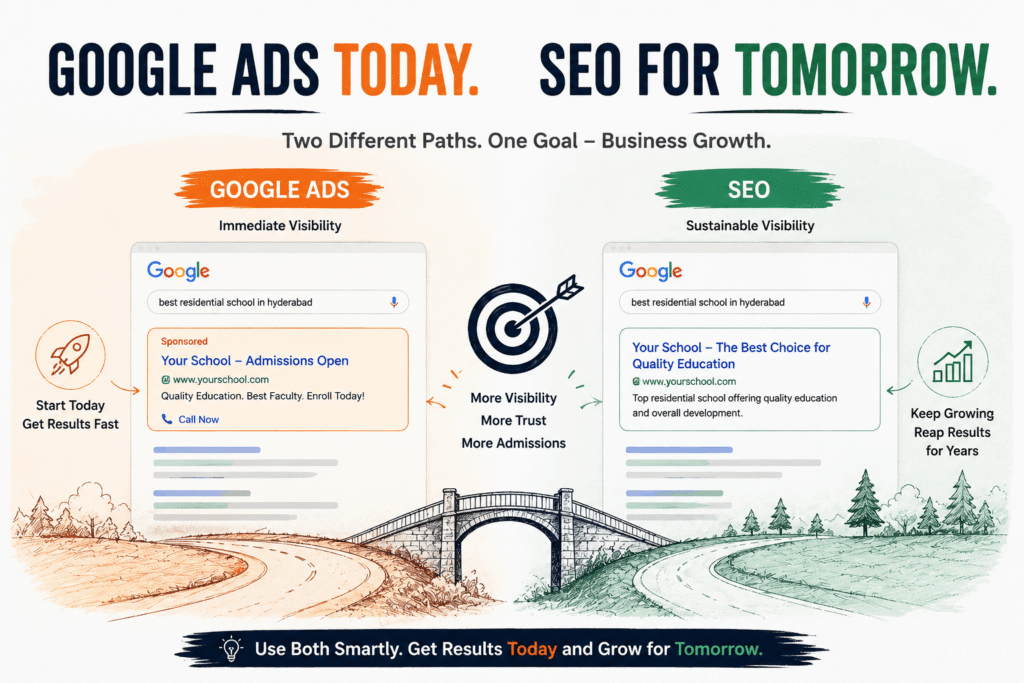
For many businesses, this is the approach I prefer.
Use Google Ads for the immediate requirement while building SEO for the long term.
You don’t need to wait for SEO to work before generating business.
And you don’t need to depend entirely on Google Ads forever.
I saw this very clearly while working with an education client.
A School Project That Showed Me Why Both Matter
A few years ago, I worked with a residential education institution.
They were already running a residential junior college and had taken a franchise for a CBSE school.
The challenge was that this was the school’s first academic year.
The website was new.
The school had very little online visibility.
And not many people knew that a residential school had opened in that particular location.
They had already tried offline marketing, including working with agents and offering commissions, but admissions were not coming at the level they expected.
When they approached us for Digital Marketing, their target was clear:
At least 200 admissions.
Waiting for SEO alone wasn’t practical because the upcoming academic year wasn’t going to wait for Google rankings.
So our strategy included:
- Google Search Ads
- YouTube in-stream ads
- Meta lead campaigns using images and videos
- SEO running alongside all the paid campaigns
The Google Search, YouTube and Meta campaigns together contributed to 230+ admissions.
But something else happened during the campaign that made this project particularly interesting to me.
Paid Advertising Started Creating Brand Searches
Google Search Ads helped us reach parents already searching for relevant schools.
YouTube and Meta had another role.
They created awareness.
Parents started seeing the school’s name, videos and advertisements.
And as the brand became more familiar, people started searching Google using the school’s name and location.
Think about your own behaviour.
You see an advertisement today.
You remember the brand.
Later, instead of finding the same advertisement again, you simply search the brand name on Google.
That’s why I don’t always look at paid advertising and SEO as completely separate channels.
An advertisement can create the search. SEO can help you capture that search.
My First SEO Priority Was the Brand Name
Because we were spending money building awareness, my first SEO priority was straightforward:
When somebody searches for the school’s name, make sure the school’s own website is easy to find.
There is little value in spending money introducing a new brand to thousands of people if they later search for it and struggle to find the official website.
From there, the SEO strategy developed in stages.
First: Brand-name searches.
Second: Location-based and local keywords.
Third: Broader Hyderabad-related keywords.
The Hyderabad keywords naturally took more time because the competition was higher.
But by the second academic year, the school’s organic search visibility had improved, and enquiries were also coming through Google organic results.
The lesson was simple:
Advertising created awareness and branded searches. SEO was already there to capture that growing search demand.
SEO Was Working Even Outside the Admission Season
Another thing I noticed was the difference in timing.
Many schools become aggressive with Google Ads around two or three months before the new academic year.
During this period, many institutions are competing for the same parents and similar searches.
But parents don’t start thinking about schools only when admissions open.
Some research months in advance.
They search for schools, locations, curriculum, facilities, residential options and other details because they are planning for the future.
Because the website had started ranking organically, it could receive search visibility throughout the year, not only during the main advertising season.
Some enquiries might not convert immediately, but they could be followed up when the admission season arrived.
I also don’t claim that every organic enquiry was purely the result of SEO.
The institution was doing offline marketing too, including newspaper flyer insertions. A parent could see a flyer today and search the school’s name on Google tomorrow.
And that brings us to another important point.
Customers Don’t Always Come From One Channel
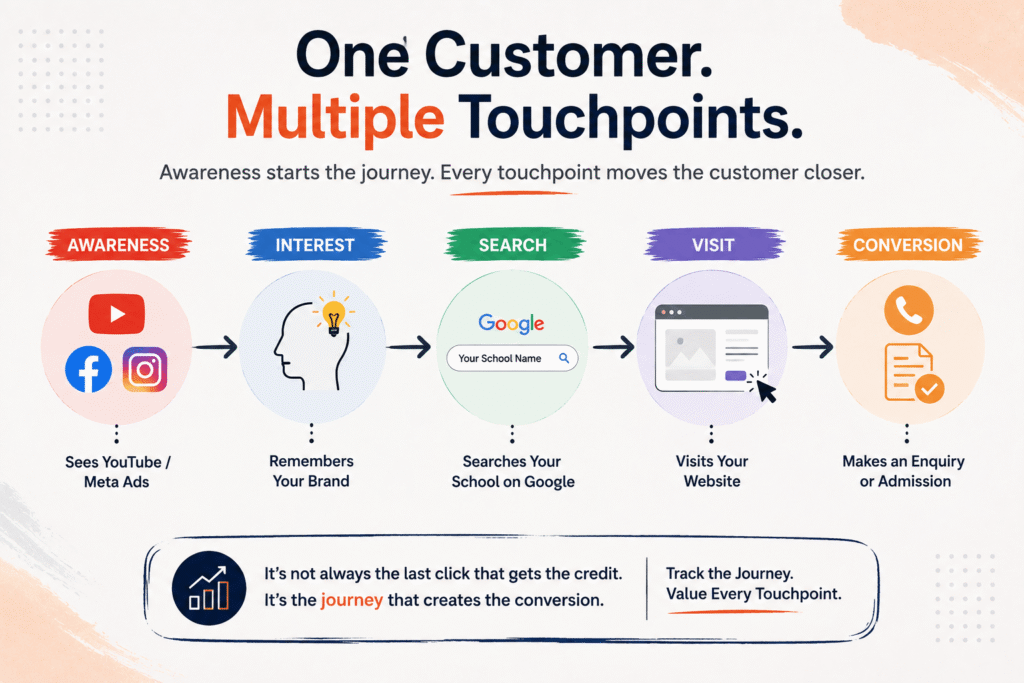
Digital Marketing attribution is not always as simple as:
Google Ads gave this customer.
or
SEO gave this customer.
A parent might:
See a YouTube ad → See a Facebook ad → Hear about the school from someone → Search the school on Google → Visit the website → Call a week later.
Which channel generated that admission?
Possibly all of them played a role.
This is why I prefer looking at the complete customer journey rather than giving all the credit to the final click.
This One Project I Always Remember
The paid campaigns crossed the original admission target.
SEO was building organic visibility at the same time.
Brand searches increased.
The website started becoming visible for relevant local and broader searches.
But the part I remember most happened after the campaign.
The owner of the institution personally came to our office to thank us.
He could have called.
He could have sent a message.
But he came personally.
Even today, I consider that one of the memorable successes of my Digital Marketing career.
More importantly, the project strengthened something I already believed:
Don’t build your entire Digital Marketing strategy around one channel.
Common Mistakes Businesses Make With SEO and Google Ads
One of the biggest mistakes I see is depending completely on Google Ads.
When Ads are generating leads, businesses sometimes ask:
“Why do I need SEO?”
The problem becomes clear when advertising costs increase, competition increases, budgets change or campaigns stop.
The business then realizes it has spent years generating paid traffic without building enough organic visibility.
The opposite mistake happens too.
A new business starts SEO and expects enquiries immediately.
SEO needs time. If the business needs customers today, waiting for rankings while competitors advertise may mean losing opportunities.
Another mistake is treating SEO and Ads as two completely separate strategies.
As the school example showed, one channel can create demand that another channel captures.
What I Recommend to My Clients
When a client asks me:
“Should I choose SEO or Google Ads?”
I don’t immediately recommend one.
I first look at the business.
What are they selling?
How competitive is the market?
Do people search for it?
How quickly do they need enquiries?
What budget do they have?
What is their long-term plan?
If the business needs immediate enquiries, Google Ads can be the priority.
If the business wants sustainable organic visibility, SEO should be part of the plan.
And if the business has the budget and opportunity to do both, I usually prefer:
Google Ads for immediate visibility + SEO for long-term organic growth.
The balance between them can change as the business grows.
SEO or Google Ads? My Answer
There isn’t one answer that applies to every business.
If you need visibility and enquiries immediately, Google Ads can help.
If you want to build organic visibility that supports your business for the long term, start SEO.
If your business needs both immediate results and long-term growth, don’t force yourself to choose between them.
Use both strategically.
Google Ads gives you speed.
SEO builds organic presence over time.
And when both are planned properly, they can support each other.
So instead of asking:
“SEO vs Google Ads: Which one is better?”
Ask:
“What combination of SEO and Google Ads makes sense for my business right now?”
Because the goal isn’t to prove that SEO is better than Google Ads or that Google Ads is better than SEO.
The goal is to generate business today while building a stronger source of business for tomorrow.