
Can Google Detect AI Content? You’re Asking the Wrong Question
Artificial Intelligence (AI) is everywhere today.
People are using ChatGPT, Google Gemini, Claude, Perplexity AI, and many other AI tools to write blog posts, emails, website content, and even books.
One question that I keep hearing is:
“Can Google detect AI-generated content?”
My answer is simple.
Maybe it can. Maybe it can’t. But I don’t think that’s the question we should be asking.
The better question is:
“Does Google rank AI-generated content?”
After working in SEO for more than 21 years, I believe that’s the question that really matters.
Before I Share My Thoughts…
There is something personal I want to tell you.
Google didn’t just become part of my career; it became one of my greatest teachers.
I started my career in SEO more than 21 years ago. Back then, there were no YouTube tutorials, online academies, or AI tools to guide us. I didn’t learn SEO through expensive courses or certifications. Everything I know today was learned by working on real websites, experimenting, making mistakes, and reading Google’s own Webmaster Guidelines.
Google gave me an opportunity to learn.
It gave me work.
It helped me build my career.
Most importantly, it helped me earn a living and support my family.
That is why I have great respect for Google Search.
Over the last two decades, I have seen Google change from simple keyword matching to semantic search, mobile-first indexing, Helpful Content, E-E-A-T, and now AI-powered search experiences. Because I have grown along with Google Search, I believe I have earned the right to share my observations on this topic.
These are not Google’s official statements. They are simply my thoughts based on practical experience.
Can Google Detect AI Content?
Many people believe Google can easily detect AI-generated content because Google itself has powerful AI technologies like Google Gemini.
Maybe that’s true. Maybe Google has systems that can understand patterns in AI-generated writing. But honestly, I don’t spend much time worrying about that.
Because even if Google can detect AI-generated content, I don’t think detection is the real issue.
Quality is.
Does Google Rank AI-Generated Content?
In my opinion,
Yes.
And also,
No.
Let me explain.
No, if…
If your entire article is copied from an AI tool without any thinking, editing, or human involvement, then I don’t expect it to perform well in the long run.
Many people simply enter a prompt, copy the output, publish it, and expect Google to rank it.
That approach creates content for search engines instead of helping people.
If the article has no originality, no experience, and no value, why should Google rank it?
Yes, if…
I believe Google can rank AI-assisted content when it is genuinely useful, informative, and supported by human experience.
This is how I personally use AI.
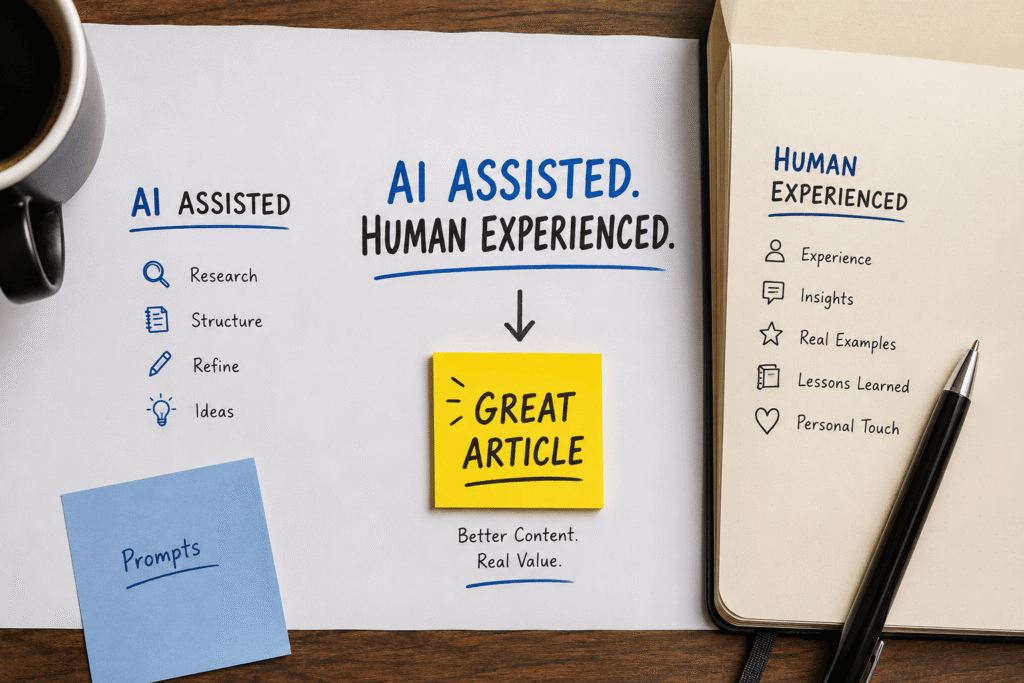
I use AI for:
- Research
- Organising my ideas
- Improving sentence structure
- Finding missing points
- Making my writing easier to read
But AI doesn’t create my experiences.
It doesn’t know the clients I have worked with.
It wasn’t there when I made SEO mistakes years ago.
It didn’t attend meetings with my clients.
Those experiences belong to me.
AI simply helps me present them in a better way.
My Own Experience
Recently, I published three articles on my website.
Yes, I used AI while writing them.
But the ideas, observations, examples, and opinions were completely mine.
Every article was based on my own experiences from more than 21 years of working in Digital Marketing and SEO.
AI helped me organise my thoughts.
It helped me improve grammar and readability.
But it didn’t create my experience.
Within a short time, Google crawled and indexed all three articles.
That made me realise something.
Maybe Google isn’t asking,
“Was this written using AI?”
Maybe Google is asking,
“Is this article useful enough to deserve a place in search results?”
What I Think Google Really Cares About
After working with Google Search for more than two decades, I believe these things matter much more than whether AI was used.
Originality
Does your article offer something new?
Or is it just another copy of what already exists?
Experience
Can readers see that the article comes from real work and practical knowledge?
Experience cannot be generated with a single AI prompt.
Search Intent
Does your article actually answer the question people are searching for?
Or are you only trying to rank for keywords?
Helpful Information
After reading your article, does the visitor learn something useful?
If yes, your content has value.
User Engagement
Do people actually spend time reading your content?
Do they find it useful enough to continue reading or explore more pages on your website?
These are the kinds of signals that show your content is helping real users.
AI Should Assist Your Writing, Not Replace Your Thinking
This is my personal opinion.
AI is one of the best tools available today.
I use it almost every day.
But I use it as an assistant.
Not as a replacement for my knowledge.
If AI writes everything and you simply publish it without adding your own thoughts, then the article becomes just another piece of content on the internet.
But when you combine AI with your own experience, observations, and expertise, you create something that no AI tool can produce on its own.
My Final Thoughts
So, can Google detect AI-generated content?
Maybe.
But after spending more than 21 years working with Google Search and recently publishing AI-assisted articles on my own website, I don’t think that’s the question website owners should be asking.
Instead, ask yourself this:
If I remove AI from my article, is there enough original thinking and real experience left that only I could have written it?
If the answer is yes, then you are probably using AI the right way.
AI can generate words.
Only you can add experience.
And in my opinion, that experience is what makes content worth reading—and worth ranking.
Disclaimer: The views shared in this article are based on my personal observations and over 21 years of practical experience in SEO and Digital Marketing. They are not official statements from Google. For Google’s official guidance, always refer to Google’s Search documentation.